
[Industry Case] Store fined {10,000} yuan for privately collecting 2200 yuan in group payments: What lessons should the head office and store each learn?
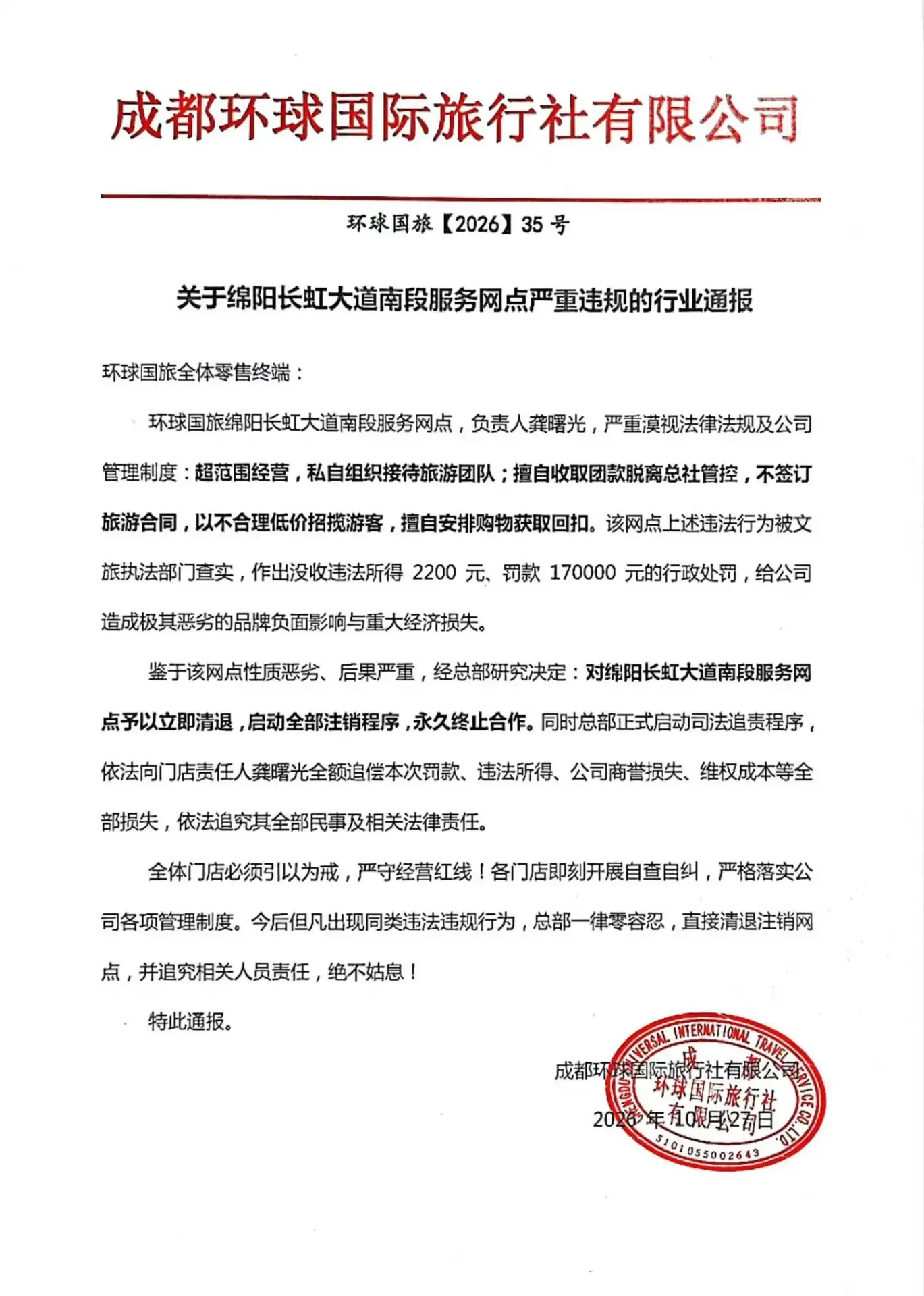
A travel agency's service outlet in Mianyang, operated by a Chengdu-based company, was penalized for an employee's unauthorized collection of tour fees. The regulatory authority confiscated illicit gains of 2200 yuan and imposed a fine of 17 ten thousand yuan. While the penalty targets the outlet, liability traces back up the management chain to the head office: gaps in authorization lists, payment controls, contract stamping, or audit mechanisms all expose the organization to risk.
The store collected 2200 yuan in group payments privately and received a fine of 17 ten thousand yuan. Compliance boundaries must not be crossed; this case is worth repeated reference by industry peers.
A service outlet of a Chengdu-based travel agency in Mianyang had its illegal income of 2200 yuan confiscated and was fined 17 ten thousand yuan by the cultural and tourism law enforcement department due to employee misconduct. While the amount isn't staggering, the real question is who ultimately bears the cost. In similar industry cases, penalties are levied against the outlet, but liability traces up the management chain. What's truly scrutinized is whether the headquarters has established proper management systems.
1. The legal business entity is the head office, but risks consistently surface at branch locations. The Travel Agency Business Operation License is held by the head office; branches serve only as service outlets. Under current regulations, service outlets may only solicit customers and provide consultations—they cannot independently organize tours, sign contracts, or collect payments. Once employees cross this line, the licensed entity remains liable for all consequences: consumers recognize the brand, not the organizational structure, and regulators and courts hold the license holder accountable. By opening branches, the head office effectively ties its operational license to a portion of performance risk.
2. Three High-Risk Violations at Store Locations: First, contractual and documentary formalism—failing to sign written package tour contracts, substituting them with receipts or verbal promises, and omitting itineraries, optional activities, and shopping arrangements from written records. When disputes arise, both parties各执一词 (disagree on the original agreement), leaving stores without evidence. Second, funds operating outside regulatory oversight—employees collecting tour fees privately, bypassing corporate accounts and system recording. Headquarters remains unaware of these transactions; the 2200 yuan in illicit gains confiscated this time followed this exact path. Third, exceeding scope of operations and product boundaries—conducting unauthorized business, organizing tour groups independently, luring customers with unreasonably low prices, and arranging shopping for kickbacks without approval. The consequences extend beyond fines, potentially triggering administrative penalties and damaging licensing credentials.
3. Four Critical Loss of Control Points at the Head Office Level - **No Authorized Scope List:** There is no clear list defining what stores can sign, collect, or which products require reporting. Everything relies on verbal agreements, leading employees to act based on their own interpretations. - **Unreconciled Payments:** Discrepancies exist between contract amounts, system orders, and corporate account receipts. The head office can only address these issues retrospectively. - **Inconsistent Sealing and Contracts:** Stores use self-made agreements and payment receipts, creating significant compliance risks. - **Absent Auditing:** Without regular spot checks of store records, violations are only discovered through customer complaints, exponentially increasing remediation costs. With all four control gaps open, the head office bears full responsibility. In response to this incident, we have terminated the outlet's operations, initiated deregistration procedures, permanently ended the partnership, and pursued full recovery from the responsible parties for fines, illegal gains, reputational damages, and legal defense costs. While recovery actions may reclaim monetary losses, they cannot offset the administrative expenses incurred or the brand depreciation already suffered.
4. Institutionalize "Direct Operation," Don't Just Brand It. The value of direct operation isn't about the signage at a store; it's about whether headquarters maintains actual control over that store. Mid-Trip International operates its offline stores as direct outlets and integrates this system with its online OTA platform. Orders, contracts, payments, and customer records are all logged in a single system, allowing headquarters to trace transactions per order and verify them monthly. Combining offline direct operations with online OTAs prevents employees from bypassing the system to solicit customers or collect payments privately. This approach is crucial before disputes arise: it ensures a complete evidence chain, clear accountability, and leaves no room for staff to circumvent procedures. Jianqian AI handles exactly this by capturing daily store activities into traceable records.
The lesson of 17 ten thousand yuan is not about the number. The headquarters must answer: Are every store's signing and payment within our oversight? Stores must answer: Is every employee's transaction within their authorized scope? Without answers to these questions, penalties are only a matter of time.
An employee at a Mianyang service outlet of a Chengdu-based travel agency was caught accepting tour payments privately. The individual's illegal gains of 2200 yuan were confiscated, and a fine of 17 ten thousand yuan was imposed.
Formalistic contract invoicing, funds not deposited into corporate accounts or system, business beyond scope, and unreasonable low-price solicitation.
Unlisted authorizations, unclosed payment loops, non-standardized stamped contracts, and absent audits—all ultimately borne by the certified entity.